Propeller Clock
A few years ago my video rental shop installed something new. On the Counter and in a protective glass orb the
size of a fishbowl a new display was spinning. It was announcing the newest VHS titles that were for rental but
my interest was more towards the device itself.
It does not seem very complex and I decided I wanted to build one myself. A quick glance in the internet
revealed the term "Propeller Clock" and the site of Bob Blick [1]
... well back then I had no idea what a microcontroller even is so the idea was put to sleep for some years.
As it happens I was going to rent a video (DVDs by now) the display catched my eyes once again, still spinning.
A new search on the internet revealed new sites too like the one from Henken [2] of which I liked the mechanic design especially.
A few quick drawings, collecting parts and a trip to buy the LEDs later the prototype was ready to be build.
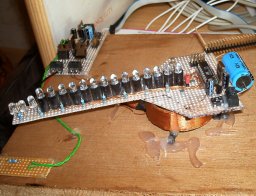
A Propeller Clock consist of 2 parts : 1. the base which is fixed containing the motor, control circuit and
part of the transformator 2. the rotor which is the spinning part containing the LEDs, another control
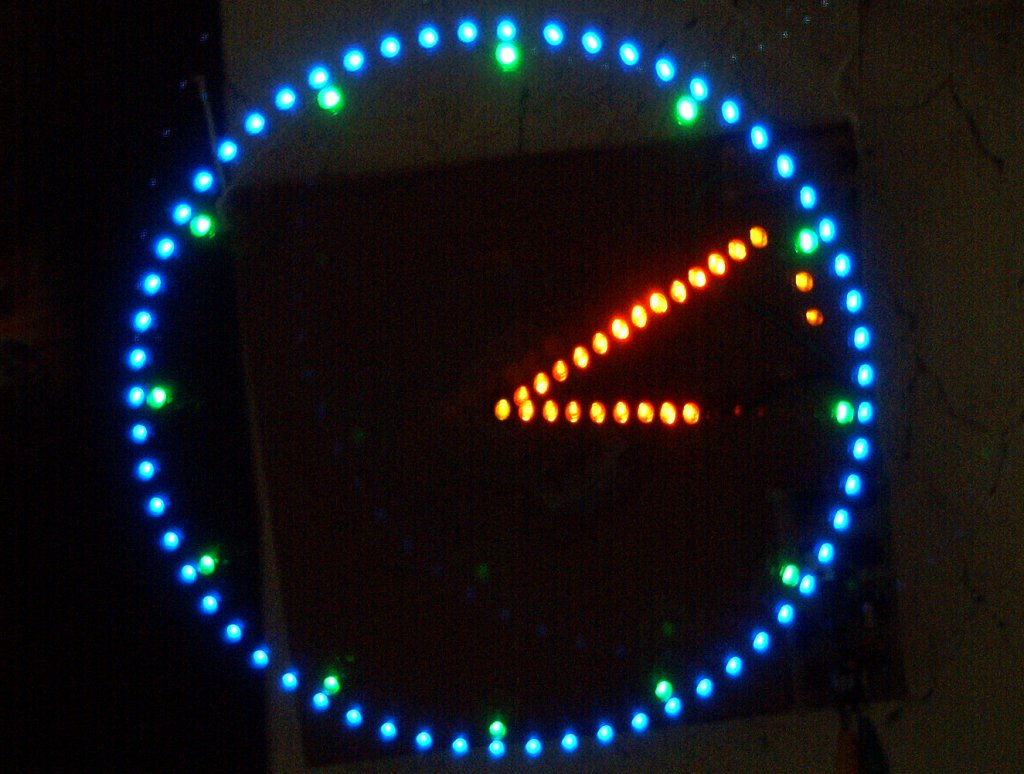
circuit and the second part of the transformator. The microcontroller on the rotor flashes the LEDs at their
correct positions (angles) creating an image of flying light points.
For every rotation the microcontroller has to know the fixed zero point from which it can counts / divide to
get the correct position for the pixels. A simple hallswitch and magnet combo works very well for this (I had
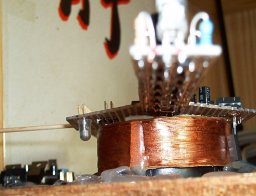
some doubts how this would work next to an air-gap transformator fed with pwm). For getting power to the
rotor the mentioned transformator works very well - one coild is attached at the base powered by a pwm and
the second coil is attached to the rotor spinning inside the other coil - picking up the pwm pulses,
rectifying them, storing them in a large capacitator and regulate them to 5 V is easily done too.
As can be seen the most important part in building it was hot glue - keeping everything in position. Not a
beauty but works well for a prototype.
The used fan is not up to the task of running fast enough or at a constant velocity for a longer time which
results in refresh rates of around 10Hz ... seeing this as an example at how it works I went on to plan my
second propeller clock.
And that is why there are no schematics here.
-
"Propeller Clock" Mechanically Scanned LED Clock [http://www.bobblick.com/techref/projects/propclock/propclock.html]
-
Propeller Clock on a Mirror [http://home.tiscali.be/henkenkatrien/propellerclock]
- 15.08.05 - transfer to new layout
- 18.11.07 - translation into english